
a media theory of the cloud factory
stuff and things!

Note: Hi! I haven’t had time to write my quarterly post, so I’m posting something I wrote for a class. I purposely took a more casual and personal tone than I normally do in my academic writing, so it felt natural to bring that voice here. I just moved back to a city and revisiting this piece felt right. Sorry it’s long— feel free to skim for the parts you like :)
My college boyfriend told me about the Cloud Factory and lent me The Mysteries of Pittsburgh shortly after we started seeing each other. One night that summer he planned for us to walk across Schenley Park bridge, right past the Cloud Factory’s tower, to watch the Perseids meteors from Flagstaff Hill, away from some of the city lights. We stopped to buy slushies at 7/11 on the way. I remember thinking, I could fall in love with this person, sitting in the damp grass among the other college kids and weed smokers and romantics. From the top of the hill, you can see the downtown skyline lit up against the sky, and the university campus looks like a maze for dolls.
The university where we met is powered by steam. The Cloud Factory is a boiler plant, one which provides energy and heating for the universities and museums which in turn provide money for the rest of the city to live. The economic center of the city is the University of Pittsburgh Medical Center. Oakland, the home to all this, is built into the side of a hill, which is flanked by another, smaller hill. Between these hills is Junction Hollow, or Four-Mile Run, or Panther Hollow, or the Lost Neighborhood. Along this subterranean seam, there’s a soccer field; a working class, somehow-still-Italian community; a lake; a parking lot; a boiler plant; and some disused train tracks. The tracks used to carry coal to the boiler plant until 2009, when it was retrofitted to burn natural gas instead. The boiler plant earned the “Cloud Factory” name possibly because of Michael Chabon’s 1988 novel The Mysteries of Pittsburgh, which he wrote as part of his MFA at UC Irvine. It was his debut novel, inspired at least partially by the summers he spent in Pittsburgh as an undergraduate. It’s quite possible people called it that before, but Chabon gets the credit now. In the novel, no one seems to know, or care, what the Cloud Factory does.
It is a mostly invisible infrastructure: it is a small building, once with two tall white towers which billowed steam, now with just one tower. I can’t find any reporting on when the second tower came down, or why, just that in Google Maps photos it happened between 2008 and 2011. I don’t remember ever seeing both, though I imagine I did. I have memories of being around the area as a kid, probably in 2008 or 2009, to visit the Phipps Conservatory and the Museums, under which the actual infrastructure of the boiler plant functions.
The steam tunnels, which house the steam pipes, run under the entire neighborhood. One imagines them being bored into the hillside with a comically large drill. Next to it is a parking garage for the museums, extending four stories below the surface level. The tunnels terminate in rooms around the universities and museums. Lore around them while I was at Pitt mostly coincided with a secret society known as the Druids, a cloaked cabal of do-gooders, who were obviously the subject of ire and gossip among the rest of the student body. The Druids actual identities were banal and predictable, student government president, sorority and fraternity leaders; just as the secret tunnels' actual contents– steam pipes and other kinds of utility infrastructure– declines further imagination. But we have to imagine that something happens in secret, otherwise why would it be secret?
In Shannon Mattern’s Deep Mapping the Media City, she resists the banality of urban infrastructure, instead asking, “What if we took media and network archaeology literally, and borrowed a few tricks from archaeologists of the Indiana Jones, rather than Friedrich Kittler, variety? What if we picked up their trowels and surveying tools?...productively “confusing” media archaeology and archaeology proper” (Introduction). One such archaeological site could be a map of tunnel entrances from Carnegie Mellon University, written by student Dennis Moul in the 1980s on a Mac Hypercard as part of an application showcase. The full interactive map has been mounted on an emulator on Internet Archive (Moul).
The map, itself an archived object, is perhaps our Indiana Jones map. Before we can discover it fully, exploring the sites of entry into the steam tunnels on campus, we see this invitation.
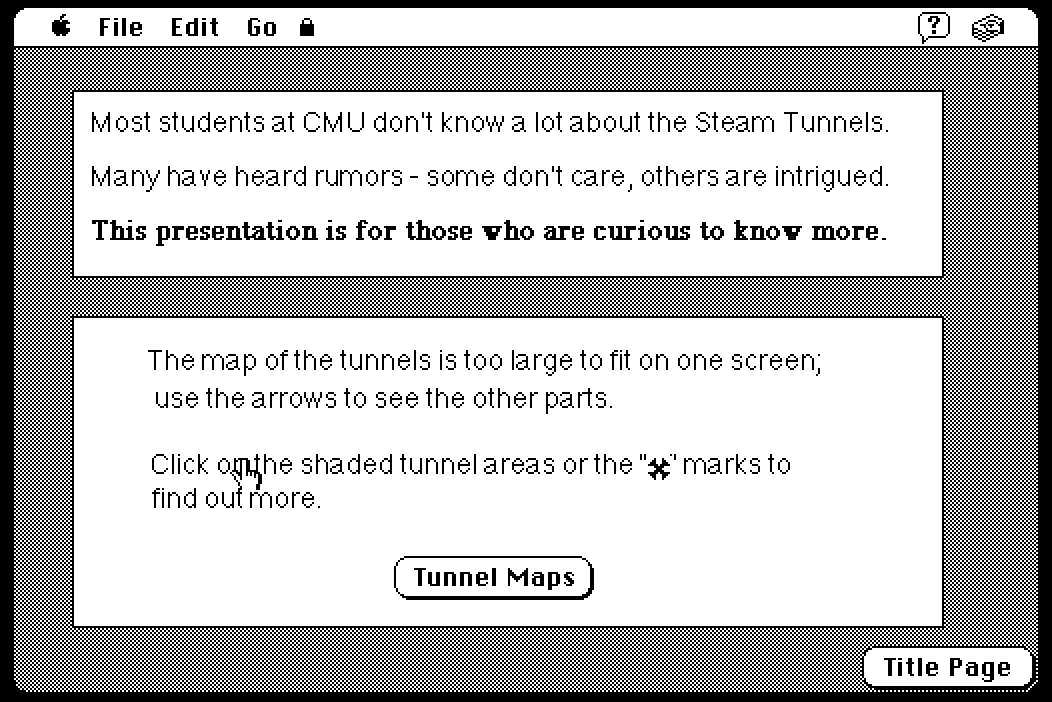
“Rumors” are decentralized information, inspiring intrigue in some and embedded in the map’s hyperlinked content. Curiosity is the only possible use for this map; entering the tunnels was against CMU’s student handbook, and is still forbidden today: “Because of the danger to all who enter them, the steam tunnels are locked and anyone found in the tunnels will be subject to serious disciplinary action and/or criminal action” (from The Word: Student Handbook). “Danger to all who enter them” is foreboding, a sort of “here be dragons” from an already strangely Biblical rulebook. The University of Pittsburgh’s student conduct handbook has no such guideline; are the students less curious, or are the tunnels themselves just better secured? The 1980s CMU map suggests, as you click through the sites, marked with an “X”, that the security of steam tunnels was lax, and mythological fraternity pledges may have already plundered the lair.
Neither our map nor the injunctions we find against using it explain what we will find down there. Digging in further, we have to look to the people who attend to the infrastructure. Interviews with the laborers who maintain the steam system were fodder for the university marketing machines circa 2005: one article from University Times, the faculty and staff newspaper of the University of Pittsburgh, takes Steamfitter foreman Paul Werley as its subject. The profile follows Werley through the tunnels and the sensory experience of them.
Not a place to linger, the cement tunnel from Posvar Hall to the Bellefield boiler Plant is large enough to stand and walk in easily, but the average temperature of 110 degrees, no matter the season, makes for sweaty work. The very presence of the steam lines — carrying steam at 175 pounds per square inch of pressure at about 388 degrees — creates dry heat in the tunnel.
But Werley said he is used to the blistering heat. When he has to check some valves or make a repair, he makes sure he brings plenty of drinking water with him (Thomas).
That the labor is dangerous and unpleasant is not surprising to anyone who knows a Steamfitter. It’s a highly paid trade with a strong union presence in spite of the decades long federal destruction of organized labor in the United States. Werley and his team’s work, according to the article, was coordinated by a system of computers, sensors, and schedules which produce tickets for maintenance. The network of steam is not normally accessed by the tunnel entrances, but by the sensations it produces in the classrooms, offices, and halls of campus buildings: a drying coolness during the hot, humid summers and a gentle heat in the winters, controlled by sensors, thermostats, and the sensations experienced by those inside. One summer, I worked as an event manager on campus, and was in turn the complaint center for the network of guests who were always cold. In turn, I would email someone who ostensibly had some command over this feedback, who made it legible to the system itself. It never got any warmer inside, and I took to leading event guests outside during breaks to sun themselves like lizards on the sidewalks.
I have so far oscillated quite close to the surface of this network, only digging in far enough to retrieve the first hand accounts of being in the tunnels from those who are authorized to go there. There is a temporal dimension to this archeology, but it’s a relatively boring one– like a lot of infrastructural history. Early in the 20th century, the plant and its steam tunnel network was built to support the Carnegie Institute, which houses the Carnegie Library, Music Hall, and Museum today. As the Carnegie, Phipps Conservatory, University of Pittsburgh, and Carnegie Institute of Technology (now CMU) expanded around it, the network of tunnels and steam pipes expanded too. Expansion and modernization, at turns, throughout the century. The Bellefield Boiler Plant took in a greater quantity of coal from the railway cars and produced a greater quantity of steam. The city now calls the Bellefield system the Oakland Energy District, one of a number of coordinated energy systems used by multiple institutions. In 2009, the Bellefield plant switched from coal to natural gas, after years of air quality complaints:
In 2006, the owners paid $175,000 fine and agreed to use a cleaner fuel mixture of coal and natural gas after the plant exceeded county air pollution limits for particulates and sulfur dioxide emissions during a stack emissions test in December 2004. The Bellefield plant also was fined $675 for exceeding sulfur dioxide and nitrogen oxide emission limits in 2003.
It most recently was cited by the health department in October 2008 for excessive visible emissions. The alleged violations were settled with an agreement to pay a civil penalty of $9,175 into the county’s clean air fund.
The health department estimated that the switch to all gas fuel at the Bellefield plant will improve air quality by cutting sulfur dioxide emissions by 99 percent, or 700 tons per year, and particulate emissions by 76 percent, or 170 tons per year (Barlow).
Originally built for its convenience to a railway which delivered all the coal required to create steam, the Bellefield plant required retrofitting in order to begin burning natural gas instead. More pipes, and less reason for the boilers to be isolated; transportation of coal having motivated the centralization of the steam network in 1900, now actively problematic as the valley is prone to flooding. A solution: other boiler plants could be introduced to the network, like the Carrillo Street Steam Plant at the top of the hill, which starting in 2009 provided heating for the upper campus and hospital buildings. Significantly smaller, and more reliable in part due to its topographical position, the Carrillo street plant is unnoticeable: no steam clouds rising from the valley under the bridge, no notable outages when that valley floods, no more sooty smoke or excessive CO2 emissions. In John Durham Peters’s description of infrastructures, they “tend to change incrementally, and have the inertia of previous innovations to build upon. They are improved up on modularly, and clearly illustrate the principle of path-dependence. They demand labor and upkeep. They are infrastructures only to the degree that they are normalized into taken-for-granteds; they have social as well as technical components” (Peters 33). The “boring” stuff which we don’t notice, which is determined by inheritance, which does not, particularly inspire, enrage, or impress. When the perceivable elements change: soot in the air, temperature in the room, buildings in our built environment, we notice.
The record of when, exactly, the second ivory exhaust tower was destroyed is not something I can find in archives on the internet, journalistic, historic, or social. Descriptions of the Cloud Factory in The Mysteries of Pittsburgh make no mention of it, though from photographs I know it existed when Chabon was writing– the Cloud Factory of the novel being only somewhat mappable to the real boiler plant, anyway. Coincidental with its switch away from coal, one imagines the tower had something to do with burning coal: one stack for smoke, one stack for steam. Which stack does Chabon’s jewel thief, Cleveland, fall from in the novel’s climactic police chase?
In that one long second before he lost his footing and fell head over heels over head, the spotlight hit him strangely, and he threw a brief, enormous shadow against the perfect clouds, and the hair seemed to billow out from the shadow’s head like a black banner. For one second Cleveland stood higher than the helicopter that tormented him; he loomed over the building, over me, and over the city of secret citizens and homes beneath his feet (Chabon 286).
Throughout the novel, which tells the story of Art Bechstein’s romantic and familial entanglements the summer after he graduates from the University of Pittsburgh, Cleveland expresses his desire for bigness, greatness, something more. The Cloud Factory is a site of that imagination, a place where characters escape from the more mundane days of school and work to have lunch, talk to their friends, smoke weed, dream. It is an effective site for dreaming; it is infrastructural to knowledge, supplying the necessary preconditions for the novel’s production, diegetically as setting, non-diegetically as a source of inspiration, and materially as the steam which heated the rooms in which the author was educated. It might be obvious to say that, and Peters argues that infrastructuralism is exactly that “fascination for the basic, the boring, the mundane, and all the mischievous work done behind the scenes” (Peters 33). Chabon, in his essay on the writing of Mysteries, emphasizes the computer he wrote on (“an Osborne 1a…it was the size of a portable sewing machine…with two 5 ¼ in floppy disk drives, no hard drive, and 64 KB of memory”, Chabon, P.S. 9) was difficult to position in the attic room he was living in at the time. Once he had intricately and precariously balanced the thing, only then could he get down to writing the novel. Mundane and mischievous, a novel is written in WordStar, the Cloud Factory makes clouds.
What is the infrastructure of infrastructure? What, for example, supports the boiler plant? For a long time, it was a railroad car full of coal. Coal is the path-dependence for all of Pittsburgh. Coal and navigable waterways, we are taught in Pennsylvania elementary schools, are the two major factors in Pittsburgh’s rise to industrial power during the nineteenth century. Steel was manufactured here because the coal used to make coke, the fuel for all steel forging done then, was here already. Coke is still made in Pittsburgh, at the Clairton Coke works, just 10 miles down the Monongahela River from the city. Burning coal for heating was nothing; the cokeworks and steel production made the city smoky. After the steel industry left in the 1970s, air quality did not improve immediately, and its structural effects remained.
The local legend is that houses were built with an extra toilet in the basement so steelworkers could come home after work and relieve themselves without tracking in soot. Many houses in my youth still had such architectural features. My grandmother told stories of her father, not a steelworker, waiting til he arrived at work to don his white shirt, because the air outside would soil it. I don’t feel a need to archive this well-documented fact, but instead I wanted to find the original designation of smokiness– from what moment onward did we start to complain about air pollution in Pittsburgh, and will we ever stop?
From Some engineering phases of Pittsburgh’s smoke problem, 1914:
The smoke nuisance is no new problem in Pittsburgh. It has been a sore spot since the very beginning of the city. The city, in the minds of some, seemed to have thrived on smoke and it came, in time, to be a symbol of prosperity. It is only at this late day, in the light of an ever growing civic consciousness, that the city is coming to realize that the smoke nuisance is the greatest handicap with which it has to contend.
Pittsburgh’s smoke problem is unique in many ways and there are extenuating circumstances connected with it. It is well known that the District is located in the heart of the bituminous coal fields, the coal from which, being very rich in volatile matter, is difficult to burn without smoke. The industries of the District use more bituminous coal than any other district of like size in the world. Pittsburgh’s topography, which bears the brunt of so many of Pittsburgh’s evils, while no cause of the smoke nuisance, intensifies and prolongs it. Pittsburgh’s irregular topography confines the smoke in “pockets” so that it cannot be readily carried away by the winds. A study of the topography will reveal the fact that the non-production of smoke is the only solution of Pittsburgh’s smoke problem” (Bellows, Introduction).
Air pollution collects in the valleys. Some mornings I would descend the cement city steps behind my boyfriend’s shitty South Oakland house to walk across the bridge, where I would eat a hangover breakfast at a joint called O’Leary’s, sitting under a Margaret Keane painting reproduction and listening to the waitresses, who were sisters, trade their South Side gossip. In mid-summer the air would thicken as I descended the hillside, surrounded by vegetation but increasingly breathing poison more than air. Many of the worst industrial smells originate from the coke works. I would wake up in the morning with a charnel taste in the back of my throat if I dared to sleep with the windows open. “Pittsburgh’s topography, which bears the brunt of so many of Pittsburgh’s evils,” is a prosaic aside in this otherwise professional report that I cannot make sense of. It is true that the topography affects your experience of air pollution still, even as visible smoke has largely disappeared from city limits. Perhaps it refers to the hoi polloi of the hillsides, the working people who, in 1914 made the steel mills and factories on the river banks run. More likely, it refers to the constant flooding and landslides to which Pittsburghers are, at this late day, pretty well-accustomed.
What is the very beginning of the city, then, or at least of the smoky city? Our archival source suggests that the first comment on its smokiness derives from a coal mine fire: “In [1766] what was known as “Coal Hill,” now Mount Washington, took fire and is said to have burned steadily for sixteen years” (Bellows 11). This seems like a myth, but mine fires have burned for longer– Centralia, an abandoned mining town in Central PA, will probably burn for another few centuries– sixteen years seems like a reasonable time. Mount Washington is the highest topographical point in the city, a spectator perch from which you can see almost everything (not the Cloud Factory). To think of a mine fire up there, where my parents were married, where we take out-of-town guests up the last remaining funiculars, is strange and disorienting. It feels like it should have been an omen for the people who chose to colonize here during and after the French-Indian war: the topography will not bear the brunt of your evils forever.
Smoke, like steam, makes the city run; is it still a “symbol of prosperity” when local industry has transitioned fully to healthcare and technology? No, and like the people who dealt with thick black smoke a hundred and ten years ago, people today are unhappy with the quality of the air. There are innumerable government reports, university studies, nonprofit efforts, and journalistic investigations into the terrible air quality today. Air quality warnings go out on the news more often than snow forecasts. Public data collection app SmellPGH is a project of the CMU CreateLab. It allows anyone with an Internet connection to submit a smell report. A color-coded, 1-5 scale, a few fields for comments, and an automatically anonymized geolocation. In this photo, courtesy of the SmellPGH website, a hand holds a phone with the reporting page open. The photo below, courtesy of the Smell PGH site, is taken in Junction Hollow, and the train tracks and smoke stack in the background belong to the Bellefield Boiler Plant.
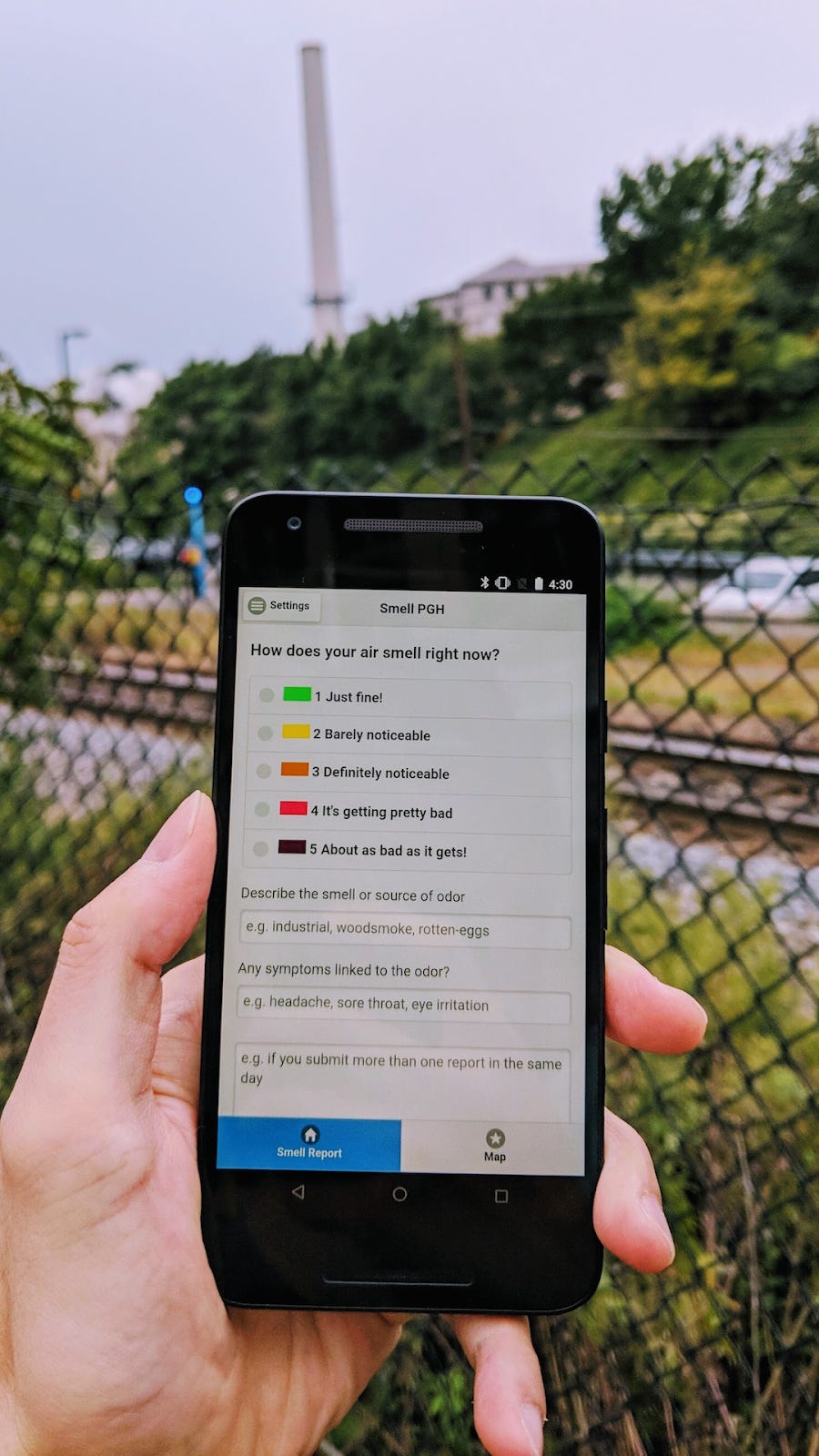
The app has been collecting reports since 2017. Their findings, which are detailed in a pretty publicly accessible report here, are largely that people report pollution in the mornings, that users are more likely to report on heavy pollution days (as opposed to reporting good or neutral smells on lower pollution days), and the biggest offender is hydrogen sulfide, which smells like rotten eggs. All of this tracks closely with what it’s like to live there. The visualizations on bad days are bad, and sparse on days with clean air. This screenshot from January 10, 2025 is not unusual. Data is available for download, and through an API. According to the project, it also shares smell reports with the Allegheny County Health Department each day. What that accomplishes, I’m not sure; it feels the same as me emailing the woman who supposedly controlled the air conditioning. But in addition to its governmental reporting, SmellPGH is a public archive of smells, particularly bad smells, for anyone who wishes to use it. The CreateLab has developed the app for other cities as well, but its features were specifically designed for Pittsburgh, for a smoky city where a public utility for smell reporting is required.
Throughout the research and thinking for this project, I realized I created a small archive of the Cloud Factory and its networks. There is an entire element of this essay, in which I might explore the relationships of dinosaurs, fossil fuels, and prehistoric imagination, in which I dig into the process of natural gas drilling called fracking and its water pollution, in which I do a Proust’s madeleine but with a rotten egg, which I do not have time to write here. I reflected on the small archive, the personal archive, as I was writing, with Hansen’s hopeful musings on Tivo and databases:
For by facilitating personal control over the flux of time – whether this be the flux of the television in one’s living room (think of the potential of TIVO and other digital storage systems) or the flux of global broadband networks and informational databases – digital technologies empower personal secondary memory to reassert some control over the production of new presencings, and thus, over the projection of the future. More simply still: because they allow personal lived consciousness control over the flux of the media artifact that is its surrogate temporal object, they allow consciousness to live time (at least to some extent) according to its own rhythms (Hansen 304).
It is possible for me to collect an archive of the Cloud Factory from 2000 miles away, spanning the building and infrastructure’s entire lifespan, intersecting with others who have experienced it, because of the technologies of storage, transmission, and computation which form our present and future imaginaries. From the same college copy of Mysteries of Pittsburgh which I boxed up and sent across the country, to the Historic Pittsburgh archives in which I find myself working ten years on from my first classroom engagement with them, I find the ability to rewind and fast-forward memory, history, smells, and more, a productive mode to engage with the media of my life.
Works Cited
Barlow, Kimberly K. “Bellefield Boiler Plant Converts to Cleaner Fuel.” University Times, 25 June 2009, https://www.utimes.pitt.edu/archives/?p=8836.
Bellows, A. B. Some Engineering Phases of Pittsburgh’s Smoke Problem: [By A. B. Bellows, A. A. Straub, and O. R. McBride]. University of Pittsburgh, 1914, https://historicpittsburgh.org/islandora/object/pitt%3A00hc01976m/viewer#page/1/mode/2up Detre Library & Archives, Heinz History Center.
Chabon, Michael. The Mysteries of Pittsburgh. Harper Perennial Modern Classics ed, Harper Perennial, 2011.
CreateLab. “Smell Pittsburgh: How It Works.” SmellPGH, https://smellpgh.org/how_it_works. Accessed 17 Mar. 2025.
CreateLab. “Smell Pittsburgh: Jan 10 Visualization.” SmellPGH, https://smellpgh.org/visualization?share=true&date=20250110&zoom=11&latLng=40.394,-79.914&city_id=1. Accessed 17 Mar. 2025.
Dennis Moul. CMU Tunnels. 1 Jan. 1988. Internet Archive, http://archive.org/details/hypercard_cmu-tunnels.
Hansen, Mark B. N. “Media Theory.” Theory, Culture & Society, vol. 23, no. 2–3, May 2006, pp. 297–306. DOI.org (Crossref), https://doi.org/10.1177/026327640602300256.
Mattern, Shannon. Deep Mapping the Media City. University of Minnesota, 2015.
Peters, John Durham. The Marvelous Clouds: Toward a Philosophy of Elemental Media. The University of Chicago Press, 2015.
TheZachMorrisExperience. “Bellefield Boiler Plant.” Wikimedia Commons, 19 Feb. 2025. Wikimedia Commons, https://commons.wikimedia.org/wiki/File:BellefieldBoilerPlantCarnegie.jpg.

Thomas, Mary Ann. “Making Pitt Work: Steamfitter Paul Werley Goes Underground.” University Times, 28 Apr. 2005, https://www.utimes.pitt.edu/archives/?p=866.
University, Carnegie Mellon. Steam Tunnels - The Word - Student Handbook - Carnegie Mellon University. https://www.cmu.edu/student-affairs/theword/community-policies/steam-tunnels.html. Accessed 17 Mar. 2025.